Charitable Planning
Tax efficiency and philanthropic intent, designed to operate together.
A way to give without subtracting from what stays in the family.
For most charitably inclined families, the question is not whether to give — it is how to give in a way that maximizes the impact on the cause and the efficiency of the transfer. Done well, charitable planning routes assets through the family's structure on the way to the recipient organization, capturing income-tax, estate-tax, and capital-gains benefits at each step.
Life insurance: another way to multiply your gift.
Three coordinated moves.
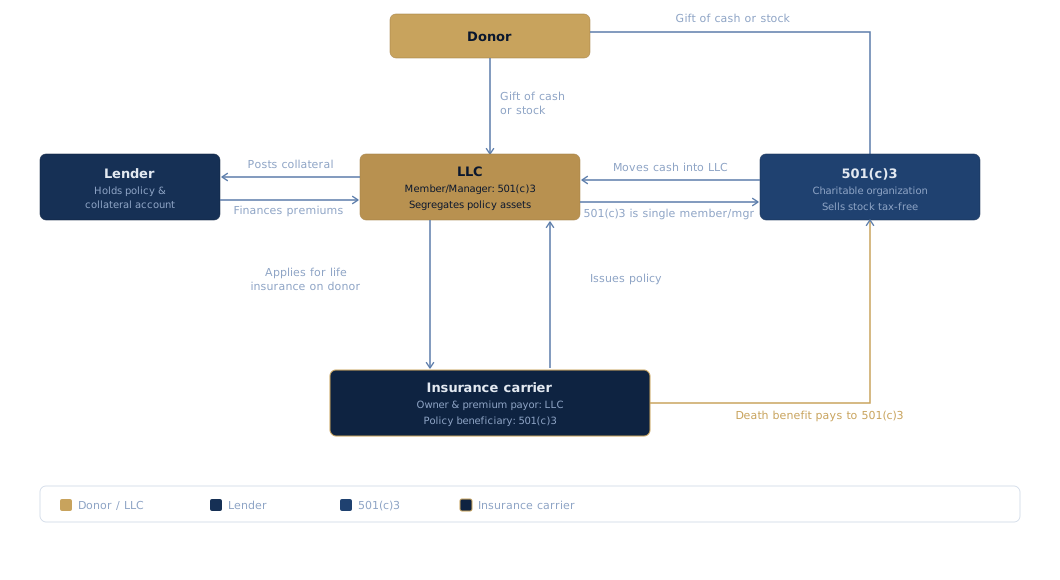
The donor makes a one-time contribution of an appreciable asset — typically stock held at a gain. The donor receives an immediate income-tax deduction equal to the asset's current fair-market value, and the asset exits the taxable estate entirely.
The charity liquidates the asset free of capital-gains tax — a benefit the donor could not have captured by selling first and donating the proceeds. The full value of the asset becomes working capital for the charitable mission.
TES works with a bank to finance a life insurance policy on the donor, using the gifted asset as collateral. Premiums are not drawn from charity funds. At maturity, the charity receives both the residual gift balance and the full insurance proceeds — a gift valued at a multiple of the original donation.
Three donor profiles.
Donors who want to make a very large gift and receive recognition — naming rights on a building, endowed chair, or program — valued at a multiple of the cash actually transferred.
Donors who believe deeply in the charitable mission and want every dollar to work as hard as possible. The structure avoids capital-gains tax, finances premiums through the bank, and delivers a materially larger gift than a direct contribution would.
Donors who have appreciated assets and want an immediate, lifetime income-tax benefit — not a deduction that only materializes at death through a will or trust, when the donor can no longer benefit from it.
How the entities connect.
Often used together.
Have a client who may benefit from advanced planning?
Whether you are working with a business owner, high-net-worth family, estate planning client, or existing policyholder, TES can help determine whether a tax-efficient strategy may add value.
We design solutions.
We empower them.
We focus on outcomes.